
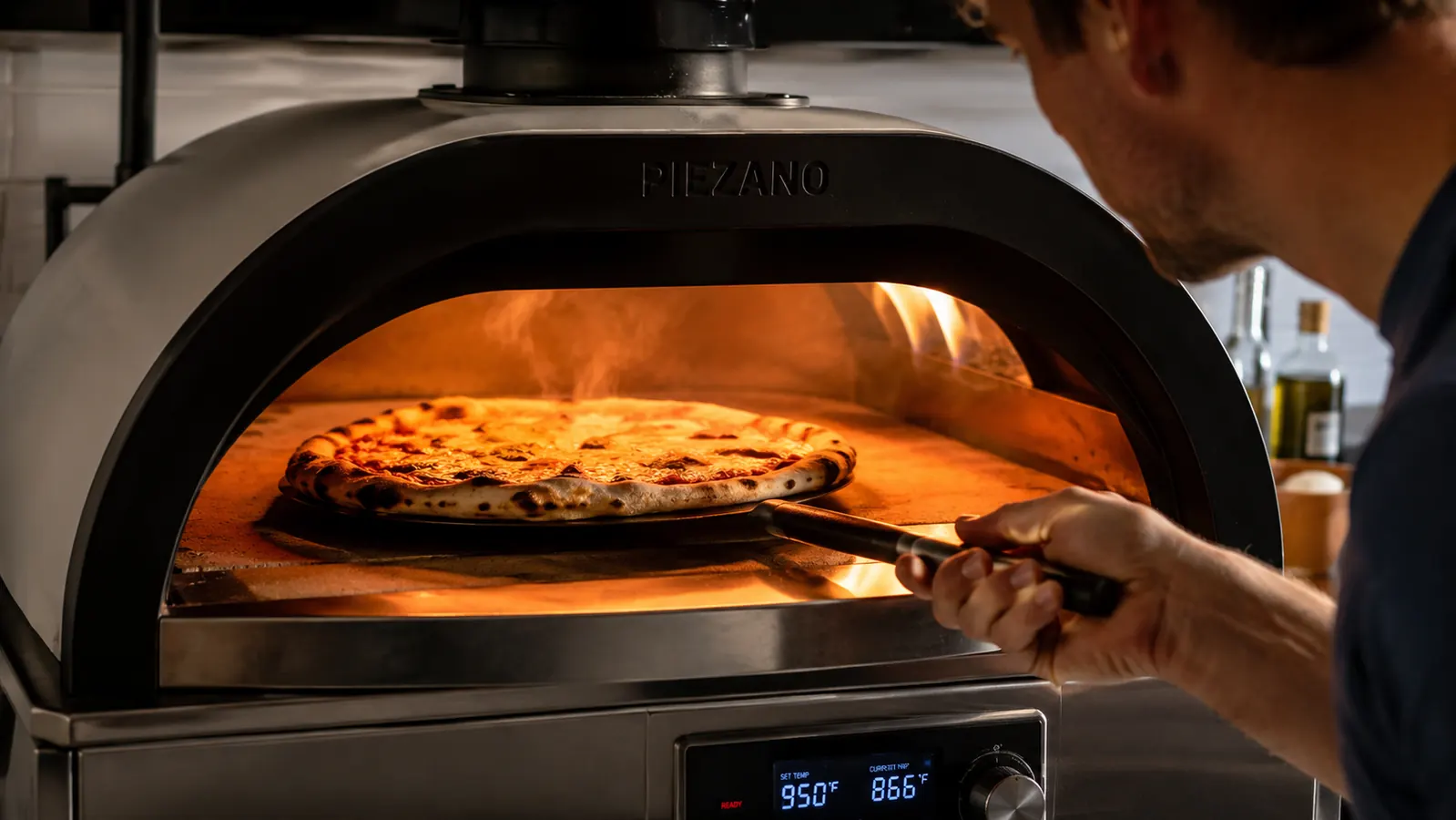
My PIEZANO showed up on a Tuesday and by Friday I'd burned two pizzas so badly the smoke alarm went off twice. Nobody mentions that part in the glowing five-star reviews. Ten weeks and 31 pies later, I still stand by the oven, but I want to tell you what the first month is actually like, because it is not the effortless restaurant-crust experience the box photos promise.
This is the honest follow-up to the long-term piece I wrote after four months of Friday nights with this thing. That article covered the ceramic stone and how it compares to an Ooni. This one is different. This one is about the mistakes, the hot exterior nobody warns you about, the size limits, and whether spending four times as much on a gas-fired alternative actually buys you anything real.
The Quick Verdict
A genuinely capable 12-inch electric pizza oven once you push through a rough first week, but the learning curve, hot exterior, and lack of a temperature dial deserve more attention than most reviews give them.
Amazon Check Today's Price →Before you burn your first three pizzas, read this
The PIEZANO isn't hard to use once you know its quirks. Check today's price and availability on Amazon before deciding.
Amazon Check Today's Price on Amazon →How I've Actually Used It
I keep the PIEZANO on a rolling cart next to my grill, plugged into a dedicated outlet, because it pulls enough current that I didn't want it sharing a circuit with anything else. It comes out most Fridays and at least one weekend afternoon a month when my in-laws are in town and my father-in-law insists on "helping" with the dough, which mostly means standing near the oven and narrating.
In ten weeks I've made 31 pizzas in it. Not all of them were good. I want to be upfront about that number because most reviews only show you the pizza that turned out perfect, lit from a window with basil leaves artfully placed. The real story includes the ones with a raw center, the one that stuck so badly to the peel it folded in half on the way into the oven, and the one my wife still brings up when she wants to tease me.
It's not that the PIEZANO is a bad appliance. It's that a countertop unit heating a stone to somewhere near 800 degrees Fahrenheit in eight to ten minutes behaves nothing like a home oven, and treating it like one is where most people go wrong, myself included.
Cleanup is the other thing nobody mentions upfront. Flour and semolina dust build up on the stone fast, and if you don't brush it out between bakes, it scorches and adds a faint bitter smell to the next pizza. I keep a small wire brush next to the cart now and give the stone a quick sweep between every pie, which takes maybe fifteen seconds but genuinely changes the flavor of the crust if you skip it a couple times in a row.
The First Five Pizzas Nobody Warns You About
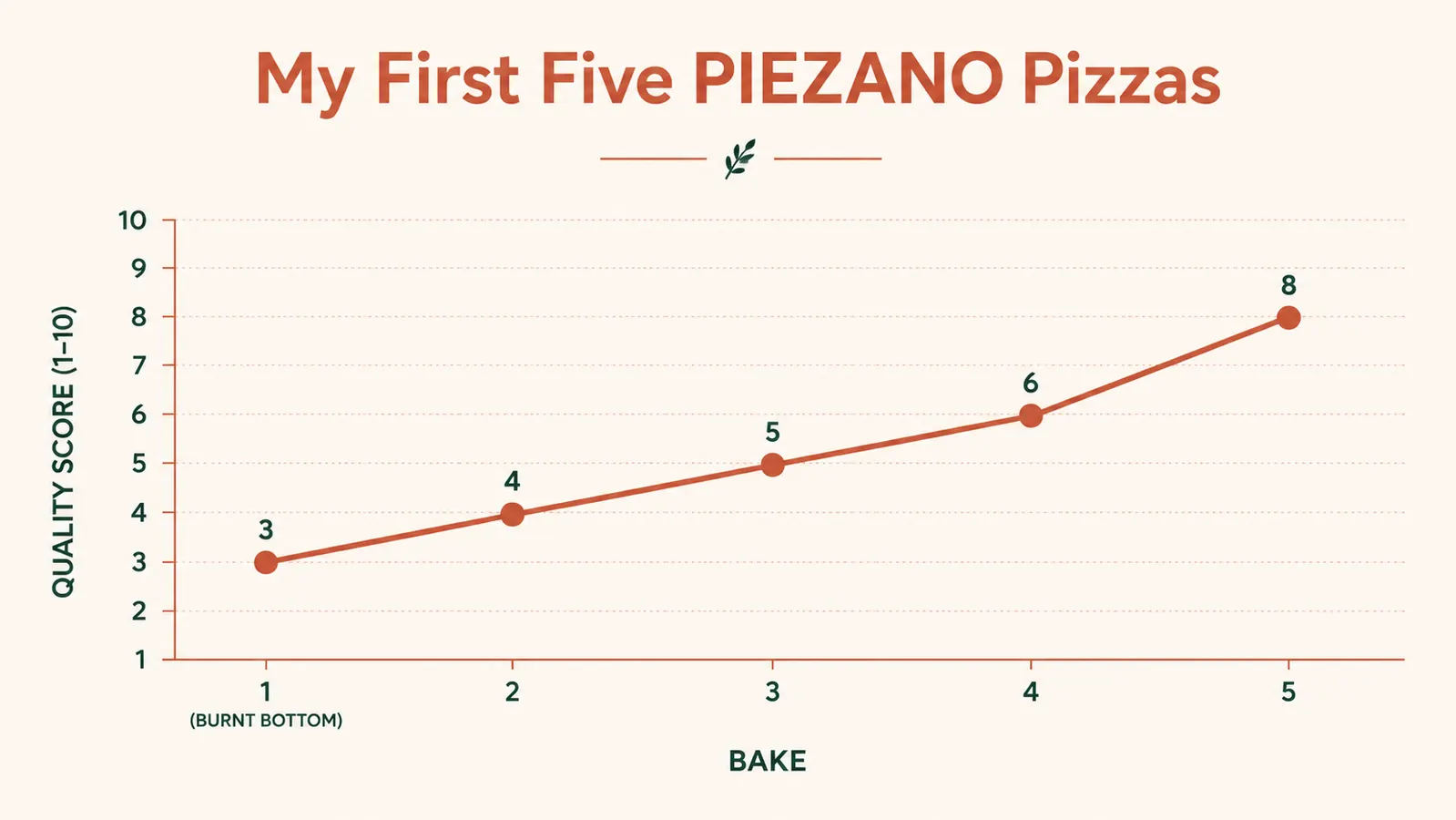
Pizza one came out with a bottom the color of a chalkboard eraser and a top that was still doughy. I'd left the dough too thick in the center and rotated too late, so the underside scorched while the toppings barely melted. I ate it anyway out of stubbornness. It was not good.
Pizza two through four were an exercise in overcorrection. I pulled the next one too early and got a pale, floppy crust with no char at all. Then I tried a thinner dough and it cooked so fast I missed the window between golden and burnt entirely, a gap that in this oven can be as short as 20 seconds. By pizza five, something clicked. I'd learned to watch the edges instead of the clock, rotate the pie with the little PIEZANO turning peel at the halfway mark every single time, and pull it the moment the cheese started to bubble unevenly rather than waiting for a uniform golden top that this oven, frankly, rarely gives you before the crust is past done.
My wife Dana kept a running tally on the fridge whiteboard those first two weeks, tally marks for good pizzas versus bad ones, mostly to tease me at dinner. Three of those early failures went straight in the trash rather than onto a plate, dough and toppings included, which stung more than I expected given how not-cheap good mozzarella and fresh basil add up to over a few attempts. If you're the type who hates wasting ingredients while you learn, prep cheap practice dough the first week and save the good toppings for once you've got the timing down.
That five-pizza stretch is the part I wish someone had told me about before I bought it. This is not a set-it-and-forget-it appliance. It rewards attention and punishes distraction, and if you're the type of home cook who likes to wander off while dinner cooks, expect a rough opening stretch before you find your rhythm.
Launching a Pizza Without It Sticking to Everything
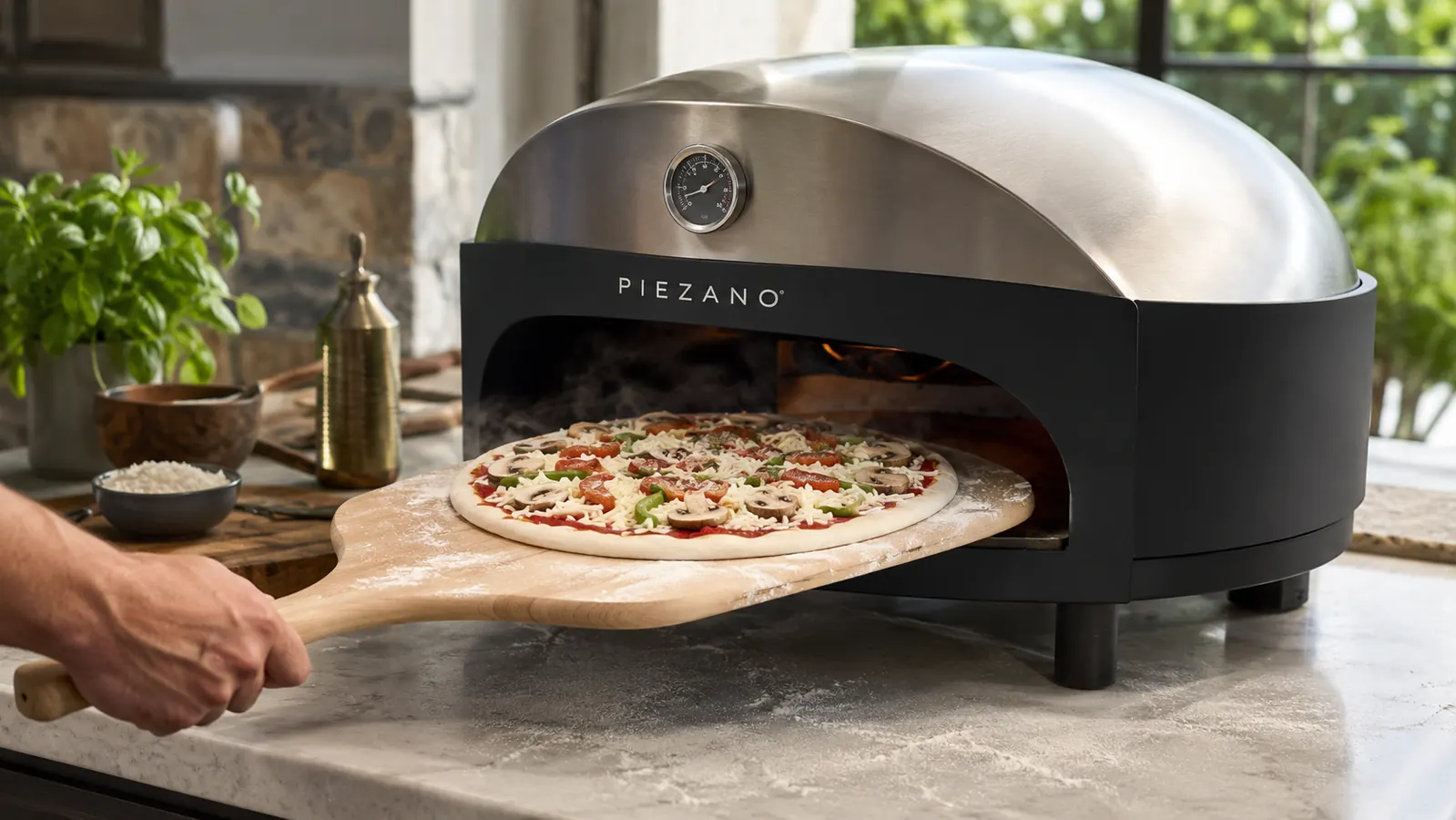
The single biggest source of frustration in my first two weeks wasn't the heat, it was the launch. Sliding raw dough off a wooden peel into a 12-inch chamber with maybe two inches of clearance on either side is a genuinely fiddly motion, and if your dough sits on the peel even 30 seconds too long, it starts sticking in patches you won't notice until you jerk the peel back and half your toppings stay behind.
What fixed it for me was semolina flour instead of regular flour under the dough. Regular flour clumps and burns fast, leaving a bitter dusting on the stone. Semolina acts more like tiny ball bearings and lets the dough glide. I also stopped building the pizza directly on the peel and started assembling it on a sheet of parchment for the first shake, then sliding the parchment out from under the pie about ten seconds before it goes in, once the dough has already released.
Even with the fix, the tight opening means a confident, fast wrist motion matters more with this oven than it would with a full-size unit. If you have shaky hands or you're doing this one-handed while holding a toddler, budget for a few sacrificed pies while you build the motion into muscle memory.
No Dial, No Digital Readout: What "800F" Actually Means Day to Day
Here's something the marketing copy glosses over. The PIEZANO doesn't have a temperature dial or a digital readout. You flip it on, it climbs toward its ceiling over about 20 to 25 minutes, and you're trusting the manufacturer's stated 800 degree Fahrenheit figure rather than watching a number tick up. I bought a cheap infrared thermometer specifically to check this, and my stone surface has topped out closer to 730 to 760 degrees Fahrenheit depending on the day, ambient temperature, and how long I let it soak.
That's not a dealbreaker, real Neapolitan ovens run hotter than most home cooks need, and 750 degrees still produces a proper leopard-spotted crust in under two minutes. But it means the number on the box is a ceiling reached under ideal conditions, not a guarantee you'll see every time you flip the switch. If precise, repeatable temperature control matters to you, the lack of any readout is going to bother you more than it bothers me.
The workaround is consistency in your own routine. I preheat for a full 25 minutes every time now, no exceptions, even when I'm impatient and the neighbors can smell dinner starting. Cutting that preheat short by even five minutes noticeably changes how the crust chars, and without a display to tell you where you stand, the clock on your phone is genuinely the only tool you have.
Outdoor temperature swings the results more than I expected too. On a cold garage-adjacent countertop in January, the same 25-minute preheat left the stone noticeably cooler than it runs on a warm September evening, and the crust took an extra 30 to 45 seconds to char properly. Without a readout to confirm it, I only figured this out by tracking bake times against the weather for a few weeks, which is more homework than a home cook should really have to do for a countertop appliance.
The Exterior Gets Hotter Than I Expected, and So Does the Counter Under It
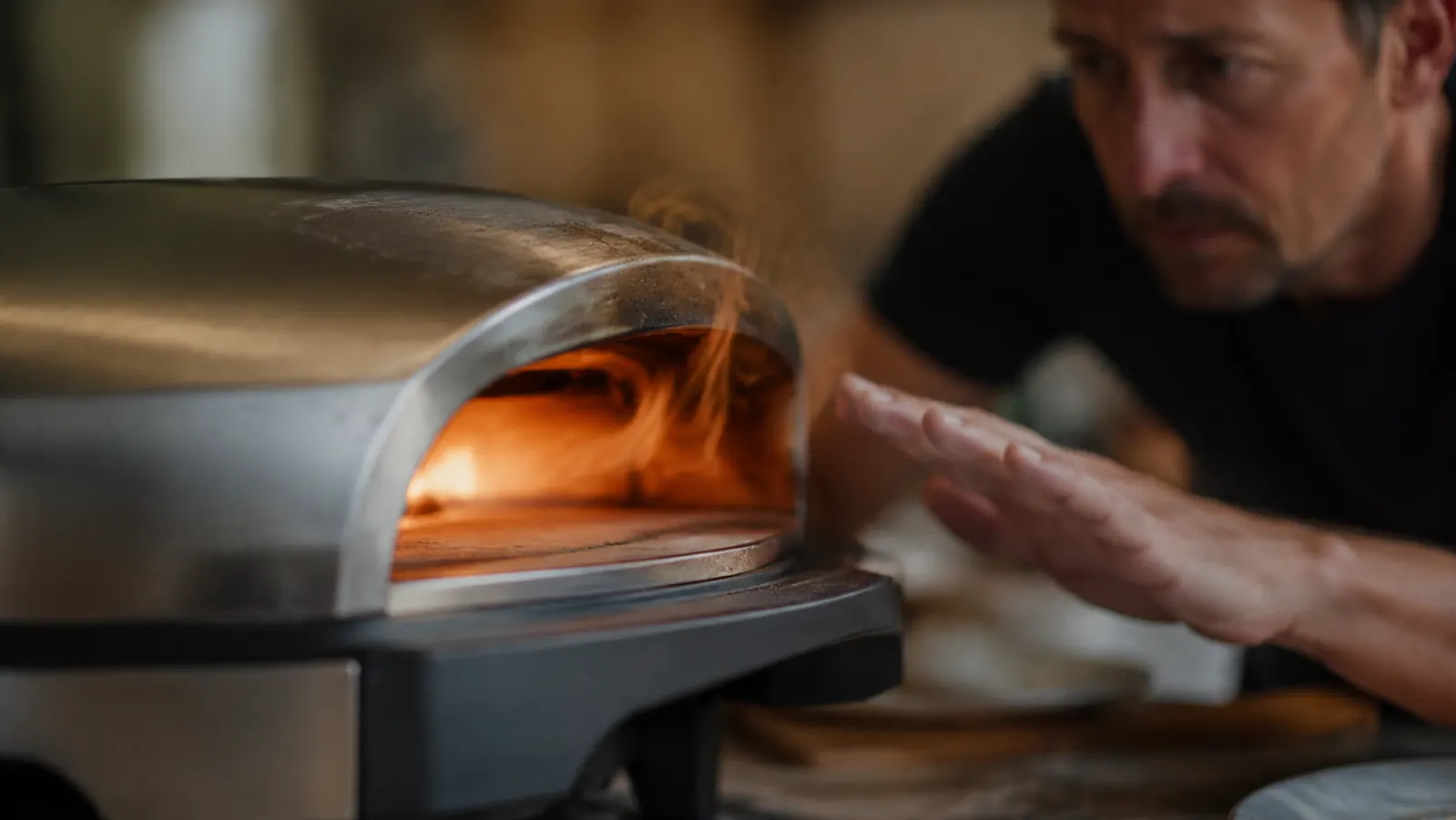
This is the part that made me nervous with my nine-year-old around. The PIEZANO's outer housing isn't just warm to the touch during a bake, it's genuinely hot within a few inches of the door opening, and the area directly above the vent gets hot enough that I don't let my son near it unsupervised. I also noticed a faint discoloration starting on the wood veneer of the rolling cart underneath it after about six weeks of weekly use, which told me the heat radiating down was more than I'd accounted for.
I now run it on a metal tray with a half-inch air gap underneath, which solved the cart issue, and I keep a strict three-foot no-kid zone in front of the door whenever it's on. None of this makes the oven unsafe when used sensibly, but the product listing doesn't do much to prepare you for how much heat radiates off a compact electric unit running at nearly 800 degrees in a chamber that small. If you have young kids or pets who like to investigate new kitchen gadgets, plan the placement with that in mind before your first bake, not after.
The 12-Inch Ceiling: Who This Size Actually Works For
Twelve inches sounds like plenty until you're rolling out dough for four adults and realize you're now on your third pie of the night because nothing bigger fits. I've settled into making individual-sized pizzas for my family of four rather than trying to stretch dough to the chamber's absolute limit, which means dinner is now four separate 15-minute bakes instead of two larger ones. That's fine for us, it's become something of a ritual where everyone tops their own, but if you're cooking for a crowd or you want one big pizza to slice and share, this oven will feel small fast.
I also learned the hard way that stretching dough past about 11.5 inches to maximize the space means the edges brush the chamber walls during the halfway rotation, which can drag toppings off or scorch the crust edge unevenly. The realistic usable diameter is closer to 10 to 11 inches if you want clean results, not the full 12 inches the name implies.
Is the Ooni Volt Worth Four Times the Price?
I get asked this constantly since I mentioned the Ooni brand in my long-term review, so let me answer it directly here. I haven't bought a Volt myself, current price alone kept me out of that conversation, but I spent an evening at a friend's house testing his, back to back with pies made the same night on my own PIEZANO using the same dough batch.
The Volt's digital temperature control and larger chamber are real advantages, no argument there. You get a repeatable number on a screen instead of a guess, and the bigger footprint means you can make a full 13-inch pizza without the edges kissing the walls. The crust texture, though, wasn't dramatically better than what I get from the PIEZANO on a good night, once I nailed my own preheat and rotation routine. The difference was consistency and convenience, not a night-and-day leap in final pizza quality.
For someone making pizza every single week for years, paying up for the digital readout and bigger chamber is a reasonable trade. For someone like me who wanted a genuinely good Friday night pizza without turning the kitchen upside down, the PIEZANO gets close enough that the price gap is hard to justify unless the display and extra size specifically solve a problem you already have.
What I Liked
- Ceramic stone genuinely holds enough heat for a two-minute Neapolitan-style bake once fully preheated
- Compact footprint fits on a rolling cart or narrow counter without dominating the kitchen
- Semolina flour and parchment-assisted launch solved my sticking problem almost completely
- Turning peel makes mid-bake rotation easy once you build the habit
- Held up structurally through 31 bakes with no warping or cracking on the stone
Where It Falls Short
- No temperature dial or digital readout, you're trusting a stated ceiling you can't verify without your own thermometer
- Exterior housing runs hotter than expected, not ideal around young kids or pets
- 12-inch chamber realistically limits you to 10 to 11 inch pies for clean results
- First five pizzas were rough while I learned timing and launch technique
- Preheat window is unforgiving, cutting it short noticeably hurts the crust
Nobody tells you the first week with a countertop pizza oven is basically a smoke-alarm tutorial. The pizza that actually looks like the box photo shows up around bake number five, not bake number one.

Who This Is For
If you want restaurant-style crust at home, don't mind a short learning curve, and you're realistic about making individual or small pizzas rather than one giant pie, the PIEZANO earns its spot on the counter. It's also a good fit for anyone tight on kitchen space who still wants real 800-degree performance without committing to an outdoor gas unit and a dedicated storage spot for it.
Who Should Skip It
If you have young kids who tend to crowd the counter while you cook, a household that wants one large pizza to slice and share rather than several small ones, or you specifically want a visible temperature readout to trust rather than a stated ceiling, look elsewhere. Those three limitations are the honest reasons some buyers end up returning this one, and they're worth knowing before you order it, not after.
I've talked to two other people in my neighborhood Facebook group who bought a PIEZANO after seeing mine and ended up sending theirs back, both for the same reason: they expected it to behave like a full-size oven with a dial and got frustrated within the first few bakes instead of pushing through the learning curve like I did. If you go in expecting a slightly different cooking process rather than a bigger, hotter version of your kitchen oven, you're far less likely to end up in that group.
Ready to get past the learning curve faster than I did?
Now that you know about the launch technique, the preheat window, and the exterior heat, you can skip most of my early mistakes. See current availability and price on Amazon.
Amazon Check Today's Price on Amazon →