
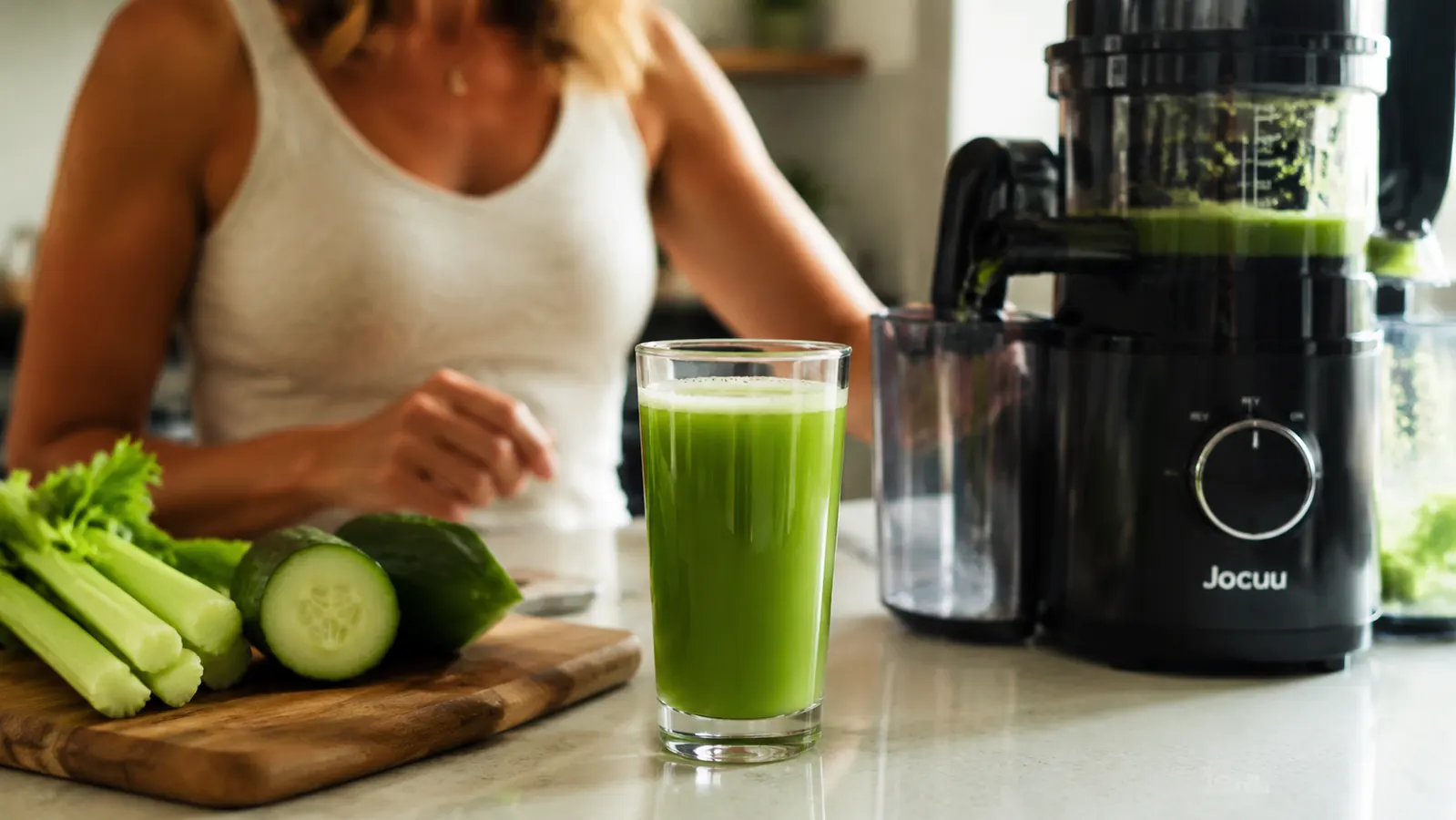
My first two weeks with a masticating juicer were honestly a little discouraging. I'd feed in what looked like a generous pile of kale and cucumber, wait through that slow, patient grinding sound, and end up with barely six ounces of juice and a pulp bin so wet it was basically salad dressing I'd thrown away. I remember standing at the counter doing math in my head, produce cost versus juice output, and wondering if a masticating juicer was actually worth the extra fifteen minutes over the centrifugal model collecting dust in my basement. It wasn't until I started treating the machine like a technique to learn rather than a button to push that my yield actually climbed, and it climbed a lot, once I switched to running everything through my Jocuu slow masticating juicer with a few specific habits instead of just winging it.
If you're getting dry pulp that still feels wet, or juice output that seems low no matter how much produce you cram into the chute, the problem usually isn't the machine, it's the prep and feeding process happening before the auger ever touches the produce. Masticating juicers reward patience and technique in a way centrifugal juicers never had to, since a masticating juicer is doing a slow crush-and-press instead of a fast spin, and that changes almost everything about how you should be loading it. Here are the five adjustments that took my yield from disappointing to genuinely impressive, in the order I'd tackle them if I were starting from scratch.
Tired of watching good produce end up in the pulp bin?
The Jocuu slow masticating juicer is the machine this whole guide is built around: a low-speed auger, two-speed modes, and a reverse function for clearing jams, all designed to extract more and waste less. Check today's price and see if it's in stock.
Amazon Check Today's Price on Amazon →Step 1: Cut Produce to Match the Feed Chute, Not the Other Way Around
The instinct is to jam whole carrots and long celery ribs into the chute and let the machine figure it out. Resist that instinct. The Jocuu's feed chute is intentionally narrow, which is part of what gives it the slow, low-heat crushing action that separates a masticating juicer from a centrifugal one, but that same narrow opening means oversized chunks get pushed through unevenly, and uneven feeding is one of the biggest hidden causes of wasted, still-wet pulp.
I cut everything into pieces roughly two to three inches long, about the length of my thumb, before it ever goes near the machine. Celery gets sliced into short segments instead of long ribs, apples get quartered instead of dropped in whole, and anything leafy, like kale or spinach, gets loosely bunched into a small ball rather than fed in as a long, stringy handful. It takes maybe two extra minutes of prep time, and the payoff shows up immediately in the pulp bin, which comes out visibly drier once the pieces are sized consistently.
One trick I picked up after a few weeks: alternate hard and soft produce as you feed, rather than running a whole batch of one texture at a time. A carrot chunk followed by a handful of spinach followed by another carrot chunk keeps the auger gripping something firm enough to push the softer stuff through fully, instead of leafy greens sliding past the auger without getting properly crushed, which is exactly the kind of thing that leaves wet, under-extracted pulp behind.
Step 2: Slow Down the Feed Rate, Even When It Feels Too Slow
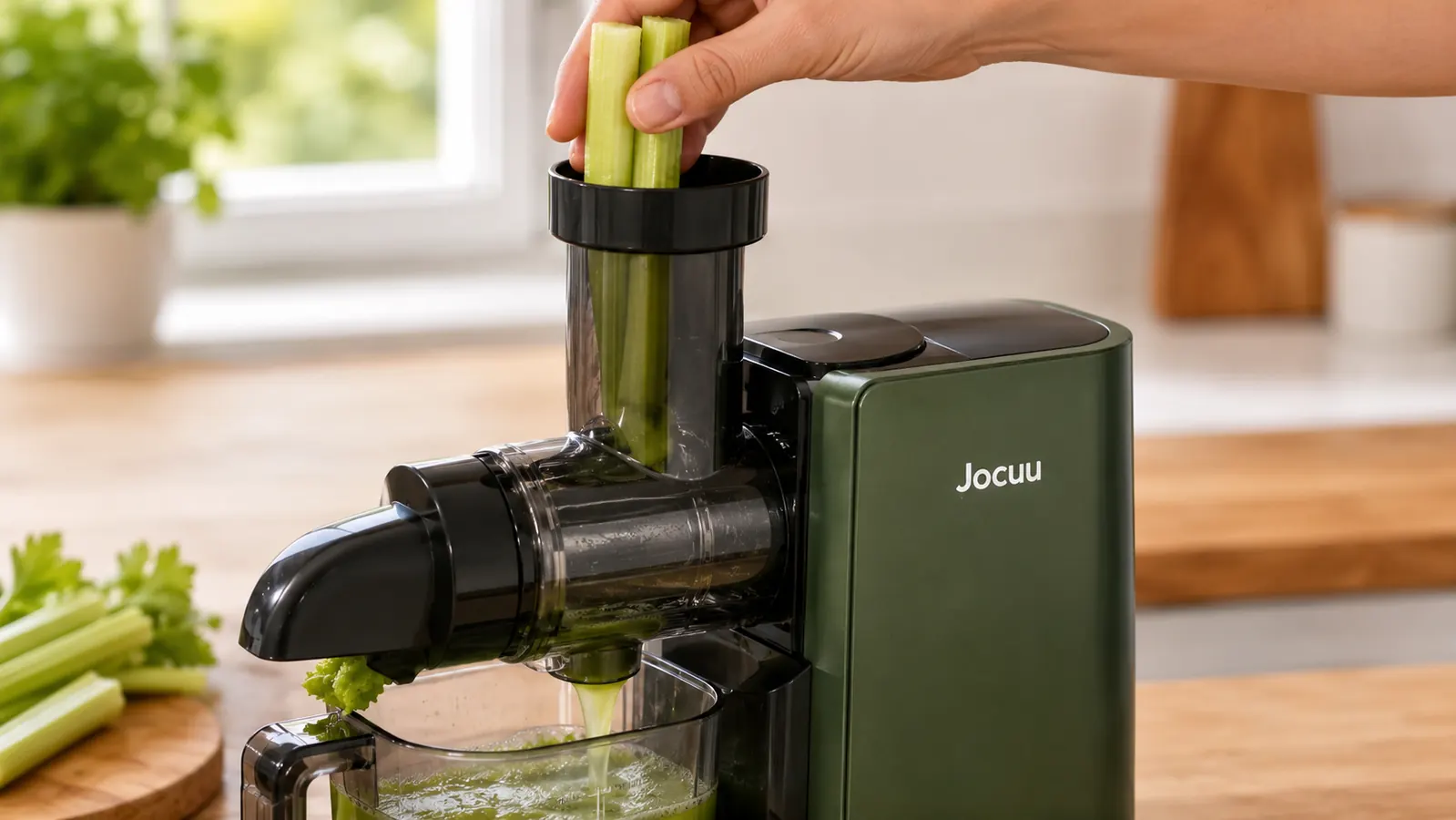
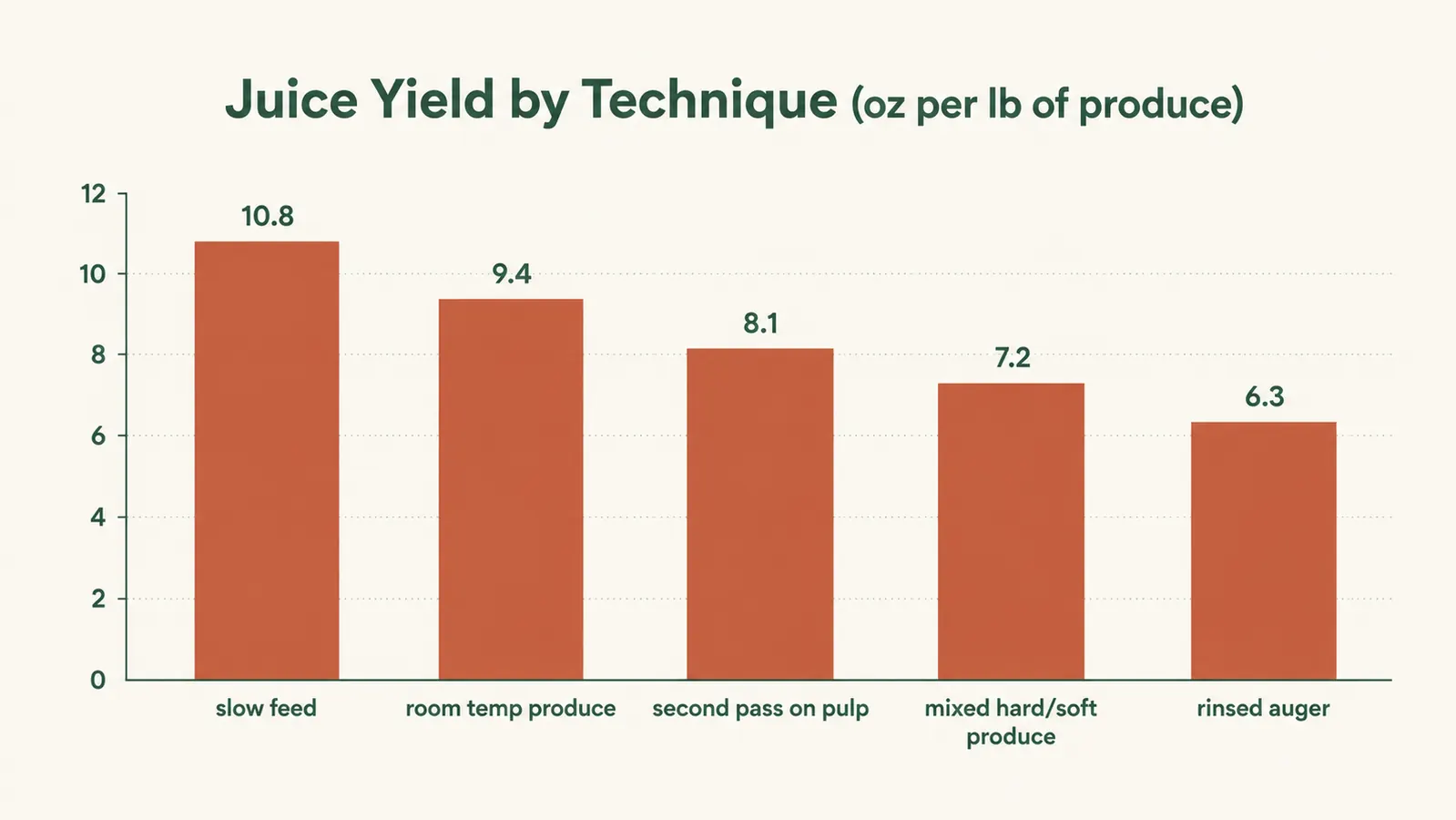
This was the single biggest yield fix for me, and it's also the one that feels the most counterintuitive, because it means going slower on purpose with a machine that's already slow by design. I used to drop produce into the chute in a steady stream, one piece right after another, the same way I'd feed a centrifugal juicer. On the Jocuu, that pace overwhelms the auger just enough that some pieces get pushed through before they're fully crushed, and every piece that exits half-crushed is juice you paid for and didn't get.
Now I let the pusher do the work at its own pace, giving each piece two or three seconds to fully compress before I add the next one. On the Jocuu's low speed setting, which is the one I use for leafy greens and soft fruit, that pause matters even more, since the whole point of the slower speed is giving the auger time to squeeze rather than shred. It genuinely feels slower than it needs to be the first few times you do it, but the pulp bin tells the real story. Mine went from consistently damp to crumbly and almost dry to the touch within the first batch I tried this on.
If you're juicing for a family and feel pressure to speed things up, resist that too. I've found it's faster overall to run one properly slow batch than to rush a batch and then have to run the pulp back through a second time to recover the juice I lost the first time around, which is its own step below.
Step 3: Run Fibrous Pulp Through a Second Time
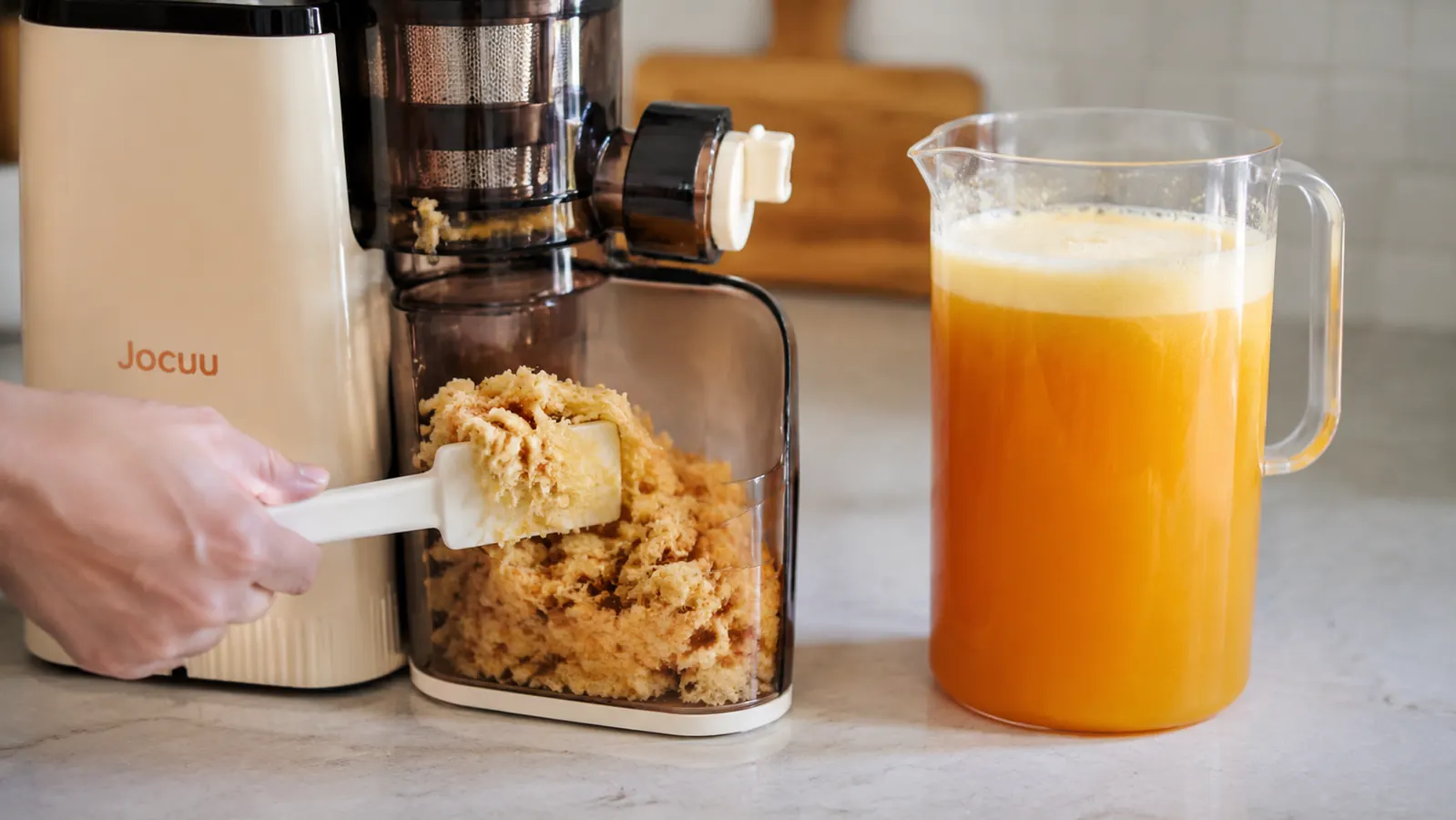
Even with careful cutting and a slow feed, fibrous produce like celery, kale stems, and pineapple core doesn't always give up everything on the first pass. I noticed this most with celery specifically, since its long fibers can slip through the auger's crushing action more easily than a dense carrot or beet does. The fix is simple: after the first batch runs through, I scoop the pulp back into a bowl and feed it through the Jocuu a second time.
The second pass usually recovers another ounce or two per batch, sometimes more with celery-heavy juices, and the pulp that comes out afterward is noticeably drier than what went in. I don't do this with every single batch, mostly because it adds a few minutes, but on any batch that's heavy in celery, kale stems, or ginger, which is dense and fibrous in a way that resists a single crush, the second pass has become a habit rather than an occasional extra step.
A quick gut check for whether a second pass is worth it: squeeze a small handful of the pulp in your fist right after the first run. If it feels genuinely damp, almost like it could drip if you squeezed harder, run it through again. If it crumbles apart dry when you open your hand, you've already gotten what you're going to get and a second pass won't add much.
Step 4: Bring Produce to Room Temperature Before Juicing
This one surprised me. I used to pull produce straight from the fridge and juice it cold, figuring that meant a colder, fresher-tasting glass of juice at the end. What I didn't account for is that cold produce is firmer and less pliable, which makes it more resistant to the auger's crushing action, especially with soft fruit like berries or citrus segments that are supposed to break down easily.
Now I pull whatever I'm juicing out of the fridge about twenty to thirty minutes before I start, just long enough to take the deep chill off without letting anything sit out long enough to worry about. The difference is subtle per batch, usually an extra half ounce to an ounce, but it adds up over a week of daily juicing, and the juice still comes out cold enough to enjoy immediately since the whole process only takes a few minutes start to finish on the Jocuu anyway.
If you're juicing first thing in the morning and don't want to plan ahead the night before, a decent shortcut is running your firmest, coldest produce, like carrots or beets, through last, after the machine and everything around it has been running for a few minutes and things have warmed up slightly on the counter. It's not a perfect substitute for genuinely room-temperature produce, but it helps close some of the gap on busy mornings.
Step 5: Clean the Auger and Screen Between Batches, Not Just at the End of the Day
Pulp buildup inside the juicing screen and around the auger doesn't just make cleanup harder later, it actively lowers your yield on every batch after the first one, since compacted fiber trapped in the screen's mesh partially blocks the juice from passing through the way it's supposed to. I didn't realize this was happening to me until I ran two back-to-back batches of the same recipe and got noticeably less juice on the second one, with no obvious explanation other than the machine itself.
Now, if I'm running multiple batches in one session, I give the Jocuu's screen a quick rinse under the tap between batches, which takes about thirty seconds since the parts pop out easily and the mesh isn't hard to clear by hand. The reverse function built into the Jocuu also helps here, since running it in reverse for a second or two dislodges stuck fiber before it has a chance to compact against the screen and start choking off flow on the next round.
At the end of a full juicing session, I do a proper wash of every removable part rather than letting anything sit overnight with dried pulp stuck to it. Dried, hardened pulp is genuinely harder to clean off later and, if any of it stays lodged in the screen for the next use, it starts the whole cycle of reduced yield over again before you've even noticed anything's wrong.
What Else Helps
A few smaller habits round out the yield equation. Layering textures within a single batch, rather than juicing all of one produce type followed by all of another, keeps the auger consistently gripping something firm, which I mentioned above but is worth repeating since it's easy to forget when you're in a rush. Storing leafy greens loosely rather than tightly packed also helps, since greens that have been compressed in a produce bag for days tend to juice up limper and less efficiently than greens with a little air around them. And don't ignore your juicer's speed settings if it has more than one. The Jocuu's two-speed modes exist for a reason: low speed for leafy greens and soft fruit, higher speed for harder produce like carrots and beets, and using the wrong speed for the wrong produce is a quiet but real source of lost yield that's easy to overlook.
More juice isn't a better machine. It's five small habits you build into every batch before the auger ever turns on.
Putting It Together
None of these five steps requires a different juicer or some special produce you can't find at a regular grocery store. What they require is treating cutting, feeding speed, second passes, produce temperature, and mid-session cleaning as part of the actual technique instead of afterthoughts you skip when you're in a hurry. On my Jocuu, stacking all five turned a machine I was lukewarm on during those first discouraging weeks into one that consistently gives me more juice per pound of produce than I expected when I bought it. The pulp bin now looks the way it's supposed to, dry and crumbly, and the pitcher fills up noticeably higher every single time.
Ready to stop losing juice to bad technique?
The Jocuu slow masticating juicer's two-speed modes, reverse function, and quiet motor make every step in this guide easy to put into practice. See today's price on Amazon.
Amazon Check Today's Price on Amazon →