

My Cosori Food Dehydrator has been living on the counter next to my stove for about seven months now, and it earned that spot by beating out a machine a lot of home preppers and jerky-makers online swear by, the Magic Mill Pro. I borrowed a friend's Magic Mill for two weekends and ran the exact same batches through both machines side by side: three pounds of marinated beef jerky, a full tray of apple chips, and a rack of dried oregano and basil from my garden. I paid attention to the stuff that matters once you're three months in, not just how good the first batch looks coming out of the box.
If you want the short answer before the details, the Cosori is the one I kept, and it's the one I point people toward first when they ask me what to buy. It costs meaningfully less, the five trays are plenty for a normal household batch, and the digital 165°F top setting gets jerky fully dried without me babysitting the machine all afternoon. The Magic Mill isn't a bad dehydrator. It's built for a different kind of user, someone dehydrating in bulk every single week, and I'll walk through exactly where it pulls ahead so you're not guessing which one actually fits your kitchen.
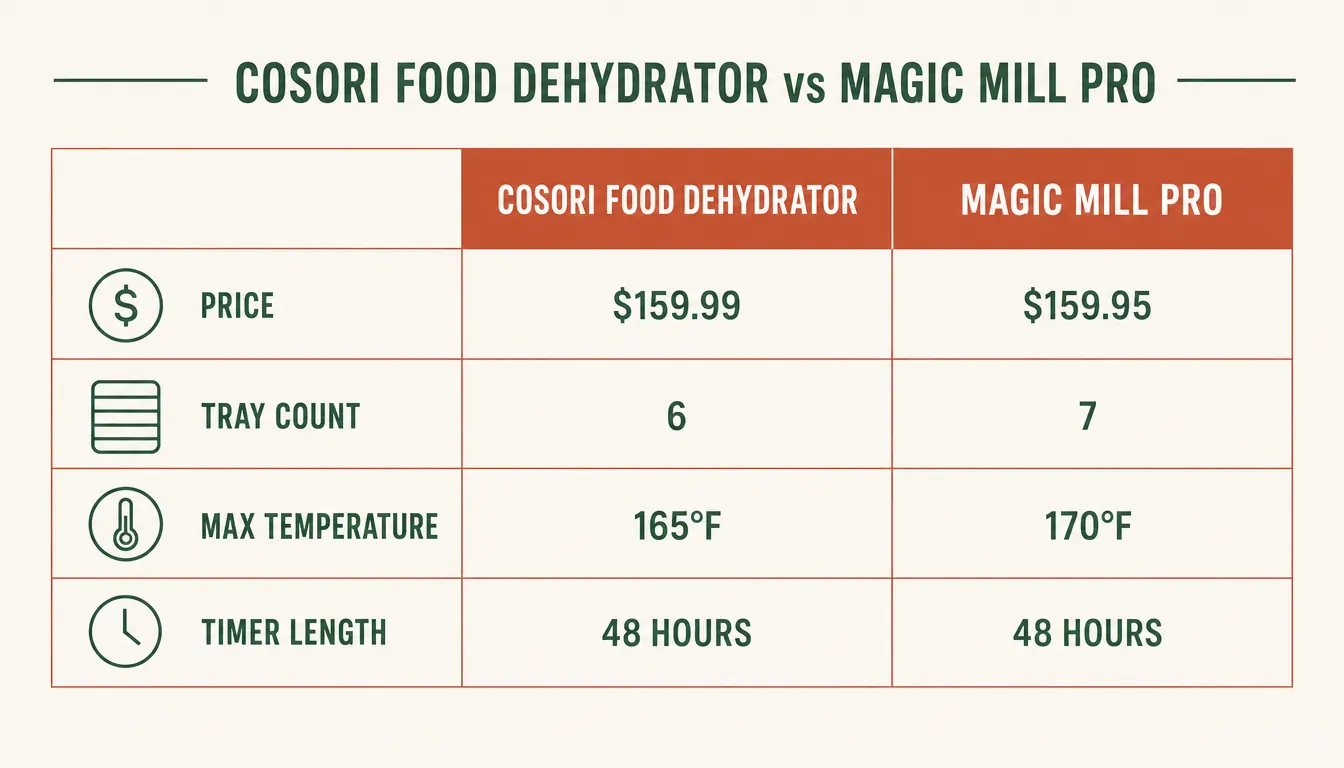
| Cosori Dehydrator | Magic Mill | |
|---|---|---|
| Price Range (typical) | Check today's price on Amazon | Premium to high-end price range |
| Tray Count | 5 BPA-free trays | 6 stainless steel trays |
| Temperature Range | 95°F to 165°F | 95°F to 158°F |
| Timer | Digital, up to 48 hours | Digital, up to 19.5 hours |
| Tray Material | BPA-free plastic, dishwasher safe | Stainless steel, dishwasher safe |
| Footprint | Compact, roughly 13 in square | Larger, roughly 15 in square |
| Included Extras | Recipe book, mesh screen, fruit leather sheet | Mesh screens, fruit leather trays, extra tray sold separately |
| Noise Level | Quiet, steady background hum | Noticeably louder fan |
| Best For | Everyday batches, jerky, apple chips, herbs | Bulk dehydrating, larger households |
Where the Cosori Wins
Price is the obvious one, and I'm not going to pretend it isn't a big deal. The Cosori runs a fraction of what the Magic Mill costs, and for an appliance that's mostly going to be turning out apple chips and the occasional batch of jerky, that gap is hard to argue with. I've talked to enough people who bought the pricier machine, used it twice, and then let it collect dust in a cabinet to know that the cheaper option that actually gets used every week wins in the long run.
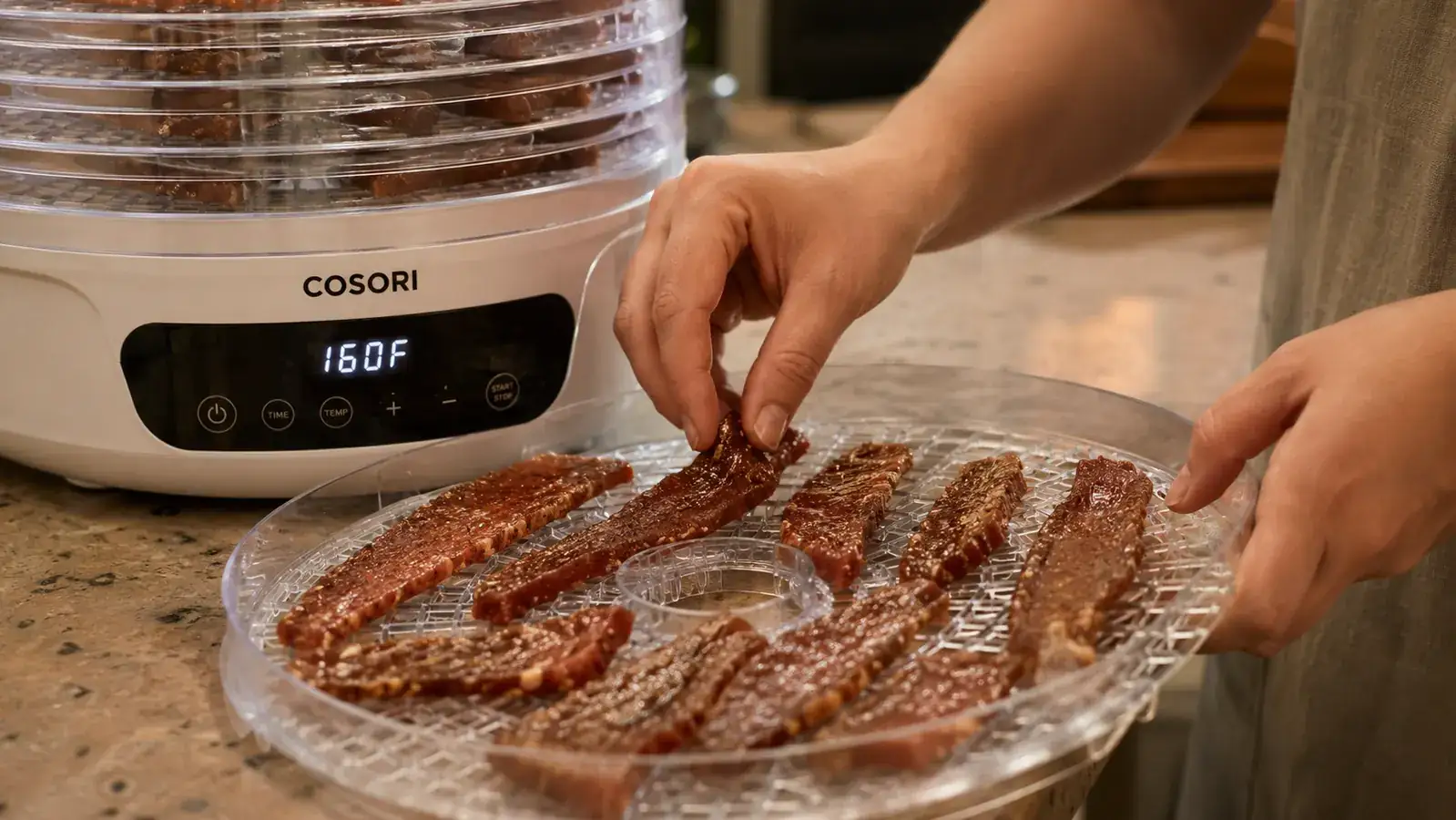
The Cosori also fits better on a normal counter. My kitchen isn't huge, and the Cosori's footprint is noticeably smaller than the Magic Mill's, so it slides in next to my coffee maker without eating the whole corner. The 48-hour digital timer is the feature I actually reach for the most, since it means I can load a batch of jerky before bed and wake up to it fully dried instead of setting a timer that maxes out well before an overnight cycle finishes. And the 165°F top temperature setting, a few degrees hotter than the Magic Mill's ceiling, matters specifically for meat, since USDA guidance for safe jerky drying leans on that higher range.
Where the Magic Mill Wins
I'll give the Magic Mill its due. The sixth tray adds real capacity, and if you're dehydrating for a family of five or you can down a garden's worth of tomatoes in one weekend, that extra tray means fewer batches and less standing around swapping trays in and out. The stainless steel tray material also felt sturdier under my hands than the Cosori's plastic trays, and it doesn't pick up the faint orange tint that plastic trays sometimes get after repeated tomato or carrot batches.
The Magic Mill's build quality overall feels a notch above, which makes sense given the price. The control dial has a more substantial click to it, and the exterior housing feels less like it would crack if you bumped it moving it off the counter. If dehydrating is closer to a serious food-preservation hobby for you than an occasional Sunday project, that extra sturdiness and capacity is part of what you're paying the higher price for.
Skip the guesswork and see today's price on the machine I actually kept
The Cosori Food Dehydrator is the one that earned a permanent spot on my counter. Check current availability and today's price before it changes.
Amazon Check Today's Price on Amazon →How I Tested Both Dehydrators
I didn't just run one tray through each machine and call it a comparison. Over two weekends I made the same marinated beef jerky recipe, the same thin-sliced Honeycrisp apple chips, and the same batch of garden herbs in both machines, using identical slice thickness and the same marinade soak time. I timed how long each batch actually took to finish, checked doneness with the same bend test on the jerky, and weighed the trays before and after to compare moisture loss. I also ran a control batch of plain water-soaked sponge cubes in each machine, a trick a food-safety-minded friend taught me, to get an apples-to-apples read on drying speed without any recipe variables like marinade thickness or sugar content skewing the numbers.
I also paid attention to the boring parts that a lot of reviews skip over: how loud each machine got running for eight or more hours straight, how easy the trays were to pull and wash afterward, and whether rotating trays mid-cycle actually made a noticeable difference in evenness. The Cosori's fan noise was consistently quieter, which mattered more than I expected once I was running overnight batches in a house where people are trying to sleep.
Tray Capacity and Batch Size
On paper, five trays versus six sounds like a small gap, but in practice it plays out differently depending on what you're drying. For jerky, both machines handled roughly the same weight of meat per tray, so the Magic Mill's extra tray meant about twenty percent more jerky per batch. For something bulky like sliced tomatoes or mushrooms, the extra tray on the Magic Mill was more noticeable, since those foods take up more vertical space and I found myself needing a second Cosori batch to get through a full farmers market haul.
For my household of three, the Cosori's five trays cover a normal batch of jerky or fruit chips without me feeling like I'm constantly running a second load. If you're preserving a big garden harvest every week or feeding a larger family, the Magic Mill's extra capacity starts to earn its keep, and that's really the core tradeoff between these two machines.
Even Drying and Noise
Both machines use a rear-mounted fan that pushes air horizontally across every tray, which is the setup you want since it dries all the trays at roughly the same rate without needing to rotate them constantly. The Cosori did require one tray rotation partway through longer jerky batches to even things out on the top and bottom trays, while the Magic Mill's slightly more powerful fan meant I could get away with skipping the rotation more often without ending up with unevenly dried pieces.
Where the Cosori pulled ahead was noise. Running either machine for eight to twelve hours means it's going to be part of your kitchen soundscape for most of a day, and the Cosori settled into a steady, low hum that I stopped noticing after the first hour. The Magic Mill's fan ran audibly louder, especially on the higher temperature settings, which is a real consideration if your dehydrator is going to live somewhere near a bedroom or a home office.
Cleanup and Storage
Both sets of trays are dishwasher safe, which honestly should be a baseline expectation at this point, but neither machine's trays are stackable in a way that saves much cabinet space once you take them off the base. The Cosori's plastic trays are noticeably lighter, which makes them easier to carry to the sink two at a time, while the Magic Mill's stainless steel trays feel more solid but add up to a heavier stack to store.
After seven months, my Cosori trays still wipe down easily with just a quick rinse for most fruit and herb batches, though jerky marinade does require an actual scrub either way, no matter which machine you own. The Magic Mill's stainless trays resisted staining slightly better on high-acid batches like tomatoes, which is a small but real point in its favor if you're dehydrating produce more than protein.
Price Per Batch: What You're Actually Paying For
A gap between these two machines isn't nothing, and it's worth being honest about what that money buys. You're paying for a sixth tray, a stainless steel build that will likely outlast a plastic one by a few years, and a slightly more powerful fan that dries a full load a bit faster on back-to-back batches. Magic Mill also backs its machines with a longer parts warranty on some models, which matters if you're running the dehydrator hard enough to wear out a motor.
What you're not necessarily paying for is a noticeably better-tasting batch of jerky or apple chips. In a blind taste test with my husband and a neighbor who also dehydrates, nobody could reliably tell which machine had produced which tray of jerky, and the apple chips came out just as crisp and evenly browned from the Cosori. If flavor and texture on the food itself is the whole point, and for most people it is, that two hundred dollar gap on the higher-end Magic Mill models buys convenience and capacity, not better results.
The Magic Mill dries a bigger batch with a sturdier tray. The Cosori dries the batch I actually make every week, quietly, for less than half the price.
Ready to see it in your own kitchen?
Check today's price on the Cosori Food Dehydrator and see why it's the one that stayed on my counter after the Magic Mill went back to my friend.
Amazon Check Today's Price on Amazon →Who Should Buy Which
If you want a dehydrator that handles regular jerky and fruit chip batches without a big upfront cost, and you don't have a ton of extra counter or cabinet space to spare, the Cosori is the easy pick. It's the machine I recommend to most people who ask me this question, because most home dehydrating is exactly that: an occasional batch of jerky, some apple chips for the kids, dried herbs from the garden, not a full-scale food preservation operation running every week. If you're feeding a big household, you garden seriously and need to process a large harvest in a hurry, or the extra capacity and sturdier stainless trays are worth the higher price to you, the Magic Mill earns its spot. It's a better tool for that specific job. For everyone else, including me, the Cosori does what I actually need at less than half the cost, and it's the one I still reach for every week. Either way, both machines will outlast a cheap forty-dollar off-brand dehydrator that struggles to hold a steady temperature, so the real decision here is capacity and budget, not whether dehydrating at home is worth doing in the first place.
See the Cosori's current price and availability
Prices on food dehydrators move around more than you'd think. Check today's price on the Cosori Food Dehydrator before you decide.
Amazon Check Today's Price on Amazon →